A backup is a type, not a promise
Every destructive call takes a token that only a successful backup produces. "Never delete without a backup" is checked by the compiler, not by discipline.
See every entry, where it lives in the registry and which program put it there. Hide it, sort it, delete it, or build your own — and every change is backed up before it happens.
No installer. No runtime library. No background service.
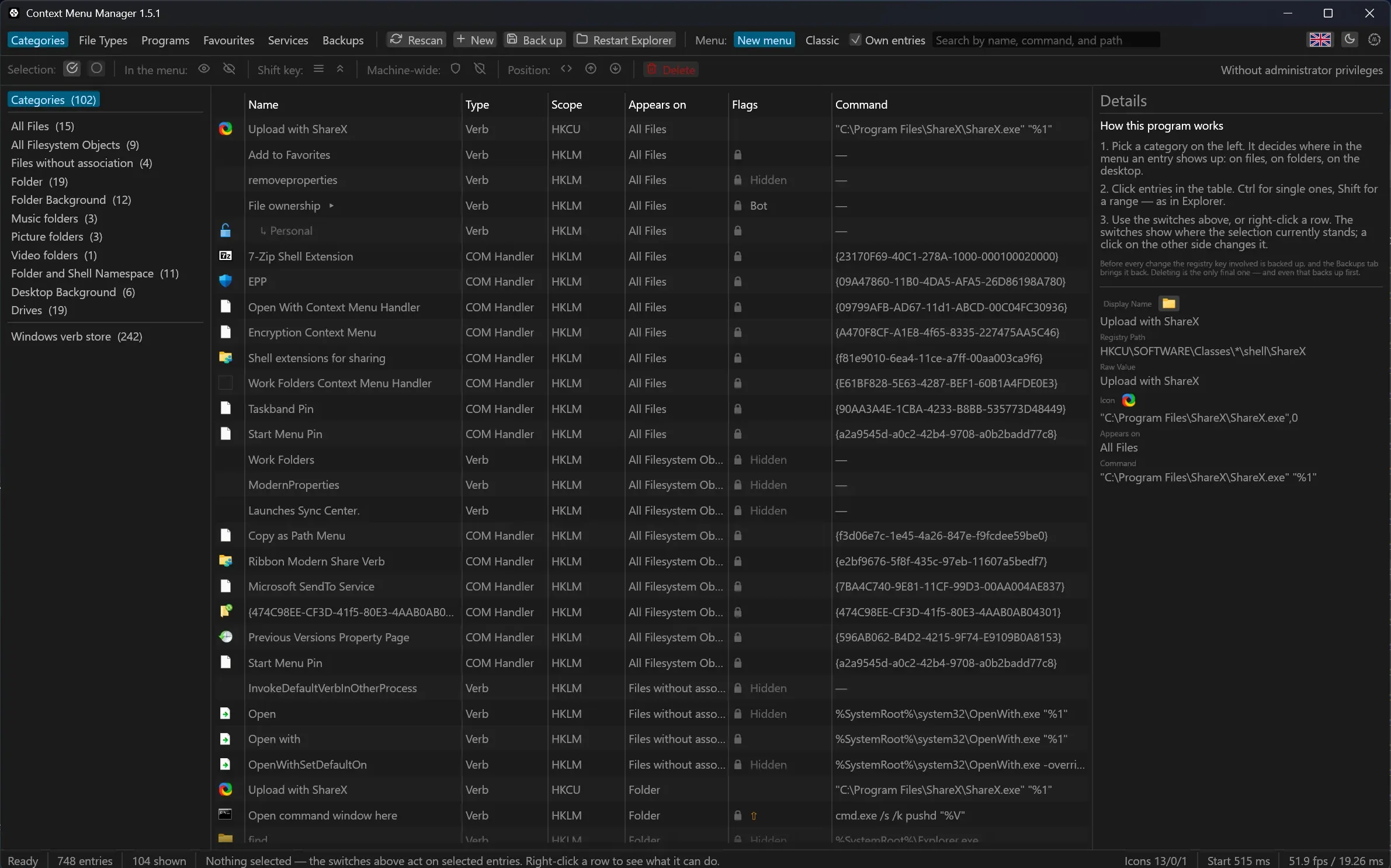
The Categories tab. Click to see it full size.
1 The entries of the Windows 11 menu are listed, hidden and created. Their order up there belongs to Explorer, and the commands it builds in itself carry no registration to reach.
2 Your own entries always go to HKCU. Changing an entry that lives under HKLM needs elevation, and it is asked for that one step only.
Six things that are mechanism rather than marketing.
Every destructive call takes a token that only a successful backup produces. "Never delete without a backup" is checked by the compiler, not by discipline.
For one extension the scan walks all seven levels Windows walks — user choice, ProgID, perceived type, SystemFileAssociations. The two levels most editors overlook are where image tools register.
Paste the docs URL of any service that describes itself through OpenAPI. Every endpoint that takes a file becomes a menu entry, grouped the way the service groups itself.
Packaged entries are read from their manifests and hidden through the per-user blocked list. Your own entries reach the upper menu through a handler the executable carries inside itself.
The program checks a signature made with a key that does not live in the repository, then the published checksum. A release without both is never offered.
A single Rust executable. No runtime library, no background service, no registry key of its own until you create one.
Not as a matter of policy. The delete function cannot be called without proof that a backup exists, and the proof is a value only a successful export hands out.
How the backups work