 ctxmenu
Contributing, security and licence
How to report a bug, how to report a vulnerability privately, and the one rule every change is measured against.
The project has one maintainer and takes changes through pull requests. The rules live in CONTRIBUTING.md, SECURITY.md and AI_POLICY.md. This page says what they contain and where each one applies.
The one rule
Measured, not assumed.
Windows behaves differently from its own documentation in more than one place. The program therefore claims nothing that has not been verified on a real system. Where a number is missing, no claim is made either. A change based on "should work in theory" is not one. A number without a date is a suspicion.
Everything else in the contribution rules follows from that sentence.
Reporting a bug
The repository has issue forms under .github/ISSUE_TEMPLATE. Pick Bug
report and the form asks for what the maintainer needs to reproduce the
problem:
- The ctxmenu version. The About window names it, and so do the file
properties of the
.exe. - The Windows version and build.
winvershows both. The build decides which menus exist on your machine. - Which menu. The new Windows 11 menu is the short one on the first right-click. The classic menu sits behind Show more options. The form also accepts "Both / not menu-related".
- Where in the program. A dropdown lists the tabs, the editor, own entries in the Windows 11 menu, the self-update and the command line.
- What happened. The steps to get there, what you expected, and what you saw instead.
- The affected registry key, if an entry is involved.
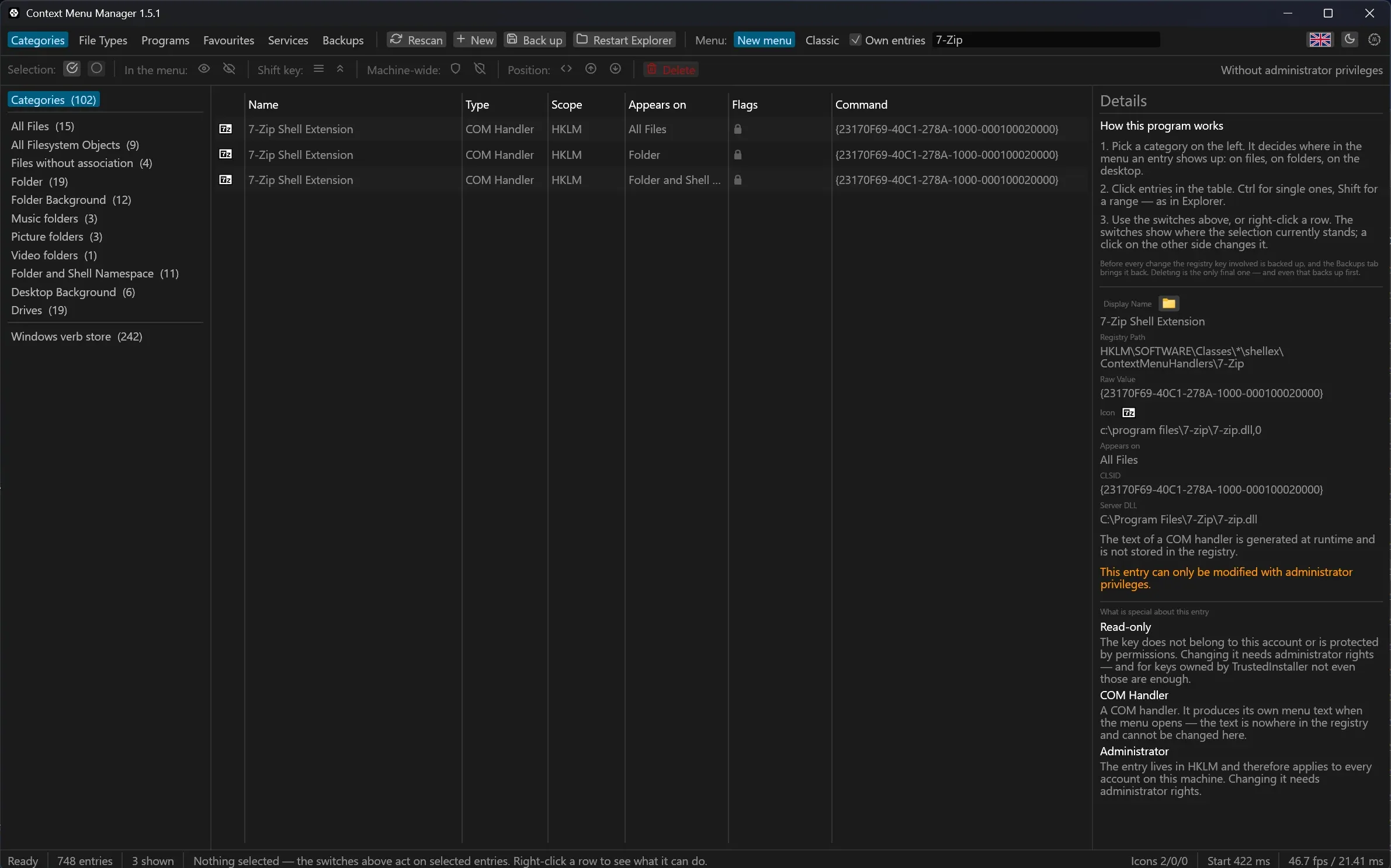
The last field is optional but it is the one that shortens most reports. The detail pane shows the full path of the selected entry and copies it with one click.
For a missing ability, pick Feature request instead. That form asks what ctxmenu should be able to do, what situation makes you want it, where in the program it would live, and how you solve it today. One ability per issue reads best.
Read the log before you paste it
The log at %LOCALAPPDATA%\ctxmenu\ctxmenu.log names registry paths and file
names from your own machine. Review the excerpt before it goes into a public
issue.
Reporting a vulnerability
A security vulnerability does not belong in an issue. An issue is public the moment it is filed, and every reader is someone who can act on it before a fix exists.
Two private channels exist, and both are fine:
- A private report through GitHub. Open the Security tab of the repository and choose Report a vulnerability. This one is preferred. The report, the discussion and the fix stay in one place, and you see the patch before it goes public.
- Email to
stefan@knaak.orgwithctxmenu securityin the subject. Nothing is encrypted on the receiving end. If a detail is too sensitive for plaintext mail, ask briefly for a different channel.
A useful report carries the same details as a bug report: the version from the About window, the Windows build, the steps to trigger it, and the log excerpt if you have one. Review the log first, for the reason above.
Only the latest release gets fixes. There is no branch on which an older version continues to be maintained.
SECURITY.md
lists what counts as a vulnerability and what does not. Four properties put the
program in scope at all: it writes to the registry, some of it under HKLM; it
requests elevated privileges and restarts itself; it sends files to addresses
the user entered and stores the keys for that; and since 1.4.0 it replaces its
own executable with one it fetched from GitHub. Plaintext keys in
%LOCALAPPDATA%\ctxmenu\ and the SmartScreen warning on an unsigned .exe are
documented behaviour, not findings.
You can expect acknowledgment of receipt within three days and an assessment within two weeks. If nothing arrives after a week, the mail was lost, so follow up through the other channel.
Sending a change
Set up the toolchain
Rust 1.95 or newer, target x86_64-pc-windows-msvc, plus the Visual Studio
Build Tools with the C++ toolchain.
Branch from origin/main
main is protected and takes no direct push, not from a contributor and not
from the maintainer. Start every change on its own branch.
git fetch origin
git switch -c feature/short-name origin/main    # or bugfix/, docs/, chore/
Those four prefixes are read by .github/release-drafter.yml, which sorts the
pull request into the right heading of the next release notes. Name the part
after the prefix in English. A branch name reaches the pull request list and
the release notes.
Run the four checks
cargo fmt --all
cargo clippy --all-targets -- -D warnings
cargo test
cargo build --release
All four must be green. -D warnings is not negotiable. The same checks run as
git hooks once you install pre-commit, and CI runs them again and decides.
Open the pull request
Three checks must pass before a merge: check for formatting, clippy and
tests, release-build for the release profile, and secrets for gitleaks over
the whole history. The branch must also be up to date with main. Rebase onto
origin/main and push with --force-with-lease when another pull request
lands first.
What a pull request is expected to contain: one test per new pure function, with a test name that is a complete sentence stating what holds; small functions named after what they do; comments that explain why rather than what; English in the code, including identifiers and comments; and a commit message in complete sentences.
Changes to the registry carry the strictest rules. Nothing is deleted without a
backup, and that is enforced by the type system rather than by review:
write::delete_tree takes a BackupToken, and the only source of one is a
successful backup::export. Write attempts against HKLM belong in a
throwaway VM.
New dependencies, rewrites without a bug behind them, features Windows does not offer, and machine-generated translations tend to get rejected.
AI tools
The project states in AI_POLICY.md that the maintainer uses AI tools when writing code for it: drafting, refactoring, tests, documentation. Everything they produce is read before it lands, and nothing is committed that the maintainer has not reviewed and understood.
Contributors may use whatever tools help them. Two limits apply. Before you open a pull request, make sure you can explain every change in the diff, not just the summary. And do not point an agent at the repository and let it file issues or pull requests on its own, because those get closed unread. The same holds for bug reports: run the code, hit the bug, then describe what happened.
German and English both work in issues and discussions.
Licence
MIT, copyright 2026 Stefan Knaak. The full text is in LICENSE. It permits use, copying, modification, merging, publishing, distribution, sublicensing and sale, on the condition that the copyright notice and the permission notice travel with every copy. The software comes without warranty of any kind.
The licences of the crates the program links against are listed in docs/THIRD-PARTY-NOTICES.md. Behaviour in issues and pull requests is covered by the code of conduct.
Last updated